


Effects, studies, and uses explained clearly
Reading time: approx. 10 minutes
Lotus is one of the most fascinating plants in the world. Few other flowers are so closely associated with tranquility, purity, and beauty. But lotus is interesting not only as a symbol—the plant is also gaining attention in skincare.
Many people are familiar with ingredients such as hyaluronic acid, vitamin C, or retinol. Lotus extract, by contrast, seems almost mysterious at first glance.
What exactly is lotus extract? Which parts of the plant and ingredients are the focus of research—and what do we know today about its significance for skincare?
We explain what lies behind Nelumbo nucifera as a cosmetic plant-based active ingredient: which lotus extracts are being studied, which compounds in flower extract are particularly interesting, what recent studies show, and what role lotus can play in modern skincare.

What exactly is lotus?
The so-called sacred lotus bears the botanical name Nelumbo nucifera. It is deeply rooted in Asian culture and has been valued there for centuries—not only for its beauty, but also for its traditional uses.
Lotus is of cosmetic interest because the plant is rich in secondary plant compounds. At the same time, it is important to understand that “lotus” does not automatically mean “lotus extract”. Scientific publications examine different parts of the plant, such as:
- flowers
- stamens
- leaves
- seeds
- rhizomes
- special callus or cell culture extracts
This is crucial to the evaluation, because the ingredients—and therefore the observed effects—can differ depending on which part of the plant is used.
Which lotus extract is used in cosmetics?
Cosmetic products use various INCI names. The one relevant to Pure Elements is:
Nelumbo Nucifera Flower Extract
This is an extract from the flowers of the lotus plant. COSMILE Europe lists Nelumbo Nucifera Flower Extract as a plant-based flower extract and describes its cosmetic function as “skin conditioning,” meaning it helps condition the skin. [1]
Findings on other parts of the plant or specially prepared extracts cannot automatically be applied to lotus flower extract.

What does lotus extract contain?
From a scientific perspective, lotus is interesting because various extracts of the plant can contain polyphenols, flavonoids, and other bioactive plant compounds.
A study published in 2025 on lotus flower extract identified, among other things, myricetin and quercetin derivatives in certain flower fractions. In the studies, these particular fractions showed the highest levels of polyphenols and flavonoids. [2]
Why are these substances interesting in skin care?
Plant-based polyphenols and flavonoids are of interest to cosmetic research, among other reasons, because of their antioxidant properties.
Antioxidants can help neutralize reactive molecules known as free radicals. Oxidative stress, in turn, plays a role in various biological aging processes in the skin.
This makes plant extracts with antioxidant potential particularly interesting for cosmetic formulations when skin care is aimed at maintaining a well-cared-for, balanced-looking complexion.
It is important to put this in context: Cosmetics do not treat skin diseases and are not a substitute for medical treatment. However, cosmetic products can help care for the skin and keep it in good condition.
Different plant parts - different research approaches
The lotus plant is particularly interesting to scientists because research focuses on more than just one part of the plant. Depending on the research question, flowers, stamens, leaves, seeds, or specialized cell culture extracts may be used.
For example, a 2022 study compared an ethanol extract from lotus stamens with an extract from the whole flower. The results varied depending on the enzyme tested. In certain laboratory assays, the stamen extract showed stronger inhibition of tyrosinase and collagenase, while no comparable advantage was found for other enzymes tested. [3]
These findings therefore cannot be understood as a general ranking of the various lotus components. Rather, they show how strongly the plant part, extraction method, composition, and measured endpoint can influence the results.
There are also interesting research findings on lotus flower extract itself: A study published in 2025 identified, among other things, myricetin and quercetin derivatives and observed antioxidant and inflammation-related effects in laboratory and cell models. [2]
This diversity is precisely what makes Nelumbo nucifera an exciting plant for modern cosmetic research.

What does research say about lotus in skin care?
1. Antioxidant properties
In a study published in 2025 on Nelumbo nucifera Flower Extract, the flower extract tested showed antioxidant activity in several in vitro assays, including DPPH, ABTS, and FRAP assays. [2]
What does that mean in practice?
Oxidative stress is one of the factors that plays a role in biological skin aging processes. The results therefore make lotus flower extract scientifically interesting for cosmetic formulations.
At the same time, it is important to put these results into context: they are laboratory studies, not clinical evidence of an anti-wrinkle effect in humans. [2]
2. Inflammation-related processes in cell models
The same study also examined inflammation-related processes.
In human keratinocytes, the lotus flower extract studied reduced the TNF-α-induced expression and release of the inflammation-related messengers IL-6 and IL-8. At the concentrations tested, there were no indications of relevant cytotoxicity. [2]
This is interesting for cosmetic research because the results provide further clues about the potential of the flower extract for skin-related applications.
However, it is important to note that these are in vitro results. They do not demonstrate a medical or anti-inflammatory effect of a finished cosmetic product in humans. [2]
3. Enzyme assays and skin aging
Some lotus research focuses on enzymes such as tyrosinase, collagenase, and elastase, which are studied in connection with pigmentation and skin aging processes, among other things.
Previous laboratory results show that different lotus extracts can affect these enzymes in different ways. It is therefore always important to consider which part of the plant, which extraction method, and which specific experimental setup were studied. [3]
For cosmetic evaluation, this means that results from individual laboratory studies provide valuable clues about possible mechanisms of action, but cannot be applied across the board to every lotus extract or finished skincare product.
4. What has been clinically studied?
What is particularly interesting is that lotus has not been studied exclusively in cell and laboratory tests.
A study published in 2023 examined a special callus extract from Nelumbo nucifera. In addition to laboratory tests, a cosmetic formulation containing this extract was tested in a small clinical study involving 21 women over eight weeks. The focus was on changes in skin pigmentation. [4]
However, it is important to note that this callus extract is a specially produced lotus ingredient and not the same Nelumbo Nucifera Flower Extract used in the Pure Elements products.
The study therefore does not directly demonstrate the effects of our formulations. However, it highlights how extensively Nelumbo nucifera is now being studied in a cosmetic context as well.
Our conclusion on the current state of research
Current research shows that Nelumbo nucifera is a botanically derived active ingredient of scientific interest for cosmetic applications.
The antioxidant properties of various lotus extracts and their content of secondary plant compounds such as flavonoids and polyphenols are particularly interesting.
Cell and laboratory studies also suggest that certain lotus extracts may affect processes studied in connection with skin aging, oxidative stress, and a balanced complexion.
A nuanced perspective remains important: composition and research findings vary depending on the part of the plant and the extraction method. Therefore, findings from individual studies should always be considered in the context of the specific lotus extract studied.
For skincare, this means: Lotus flower extract is far more than a purely decorative plant ingredient. It is a botanical ingredient that is increasingly being studied scientifically and has interesting properties for high-quality cosmetic formulations.

Which skin types can benefit most from lotus extract?
Lotus is not an aggressive trend ingredient, but fits well into skincare concepts focused on a balanced combination of hydration, lipids, and plant-based active ingredients.
It is important to note that whether a product suits a particular skin type always depends on the overall formulation—not just on the lotus flower extract it contains.
1. Mature skin
Mature skin particularly benefits from skincare focused on hydration, protection from environmental stress, and a supple feel.
Lotus can work very well as part of an anti-aging routine — especially when combined with humectants such as hyaluronic acid.
2. Dehydrated skin
Lotus itself is not a classic “moisture magnet” like hyaluronic acid.
But as part of a well-formulated product, it can be a useful addition for dehydrated skin — for example, because of its skin-conditioning and potentially antioxidant properties.
3. Demanding, stressed-looking skin
People who feel their skin looks tired, unbalanced, or is often affected by environmental factors often look for skincare that is not too irritating but still offers more than just a basic cream.
This is where lotus is especially interesting.
4. Sensitive Skin — with Care
Many people with sensitive skin are interested in botanical extracts but also want skincare that is as gentle as possible.
Whether a product is well tolerated always depends on the overall formula—not just one individual ingredient. In a balanced formula, lotus can play a very valuable role.

Why do lotus and hyaluronic acid work well together?
Lotus flower extract and hyaluronic acid serve different purposes in a cosmetic formula and can therefore complement each other effectively..
Hyaluronic acid provides hydration
Hyaluronic acid is best known for its ability to bind water. That’s why it is often used in skincare products to hydrate the skin and help it feel smoother and plumper.
Lotus brings a botanical skincare element
Lotus flower extract complements this kind of moisturizing skincare with its botanical character, skin-conditioning function, and scientifically interesting plant compounds.
Together, they create a well-balanced skincare concept
For example, in a premium anti-aging or moisturizing product, the combination of
- Hyaluronic acid
- Lotus flower extract
- nourishing lipids
- Botanical components with antioxidant potential
contribute to a balanced skincare concept.
What always matters is the overall formula—not a single “star ingredient.”
Lotus in our skincare
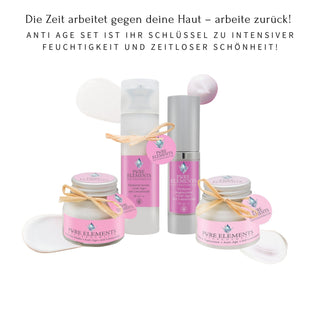
At Pure Elements, we combine lotus flower extract with hyaluronic acid and selected nourishing ingredients in our anti-aging skincare.
Discover lotus skincare →
What makes lotus especially interesting in natural cosmetics?
Lotus brings together something especially fascinating about botanical actives: a long botanical and cultural tradition, viewed through an increasingly modern scientific lens.
A botanical active beyond the familiar classics
Hyaluronic acid, jojoba oil, and almond oil have long been familiar in skincare. Lotus is much less common.
The plant contains a wide variety of secondary plant compounds and is now being scientifically studied for various properties relevant to cosmetics.
Tradition meets modern active ingredient research
Nelumbo nucifera has been valued in Asia for centuries. Today, modern analytical methods offer a much more precise look at the plant’s ingredients, including various flavonoids and polyphenols.
The overall formula is what matters
Even a special plant extract never works in isolation in cosmetics.
What matters is how it is combined with other ingredients. That’s exactly why lotus interests us: it can be incorporated into sophisticated skincare formulas where hydration, nourishing lipids, and selected botanical actives work together.
How can lotus extract be sensibly incorporated into a skincare routine?
Anyone who wants to use lotus in their skincare routine does not need to change their entire routine.
Instead, it makes sense to select products that include lotus flower extract as part of a balanced overall formulation.
A possible skincare routine
-
Gentle cleansing
First, gently cleanse the skin of makeup, excess sebum, and residue. -
Hydrating serum
A serum can add targeted hydration and selected active ingredients to your routine. -
Day or night cream
A suitable cream complements the routine with nourishing lipids and helps retain moisture in the skin. -
Targeted supplementary care
Depending on your skin’s needs, eye care or a mask can complement your routine.
What should you look for?
- the overall formulation
- individual skin compatibility
- combining it with a good moisturizer
-
regular use rather than expecting short-term miracles
Is lotus extract just a beautiful trend—or is it genuinely useful?
Lotus is far more than a flower rich in symbolism.
Current research shows that Nelumbo nucifera is a very interesting cosmetic ingredient. In particular, lotus flower extract is a plausible choice in high-quality skincare: skin-nourishing, botanically sophisticated, and scientifically intriguing enough to discuss seriously.
At the same time, honesty is important: research covers different plant parts and types of extract. Not everything can be directly applied to a finished cosmetic product.
But this is also where the fascination of lotus lies for us: it is not an ingredient about which everything is already known, but a unique plant that brings together traditional appreciation, modern analysis, and high-quality skincare.
For Pure Elements, lotus is therefore not a short-lived hype, but a distinctive botanical active ingredient that we deliberately incorporate into selected skincare formulations.

Scientific sources and further reading
Primary sources / databases
[1] COSMILE Europe – NELUMBO NUCIFERA FLOWER EXTRACT
Information on the plant part used and the cosmetic function “Skin Conditioning”.
https://cosmileeurope.eu/inci/detail/9399/nelumbo-nucifera-flower-extract/
[2] Choo JH, Lee SY, Min K, Kang NG. (2025)
Chemical Composition and Bioactivity of Nelumbo nucifera Gaertn. Flower Extract Fractions: In Vitro Antioxidant and Anti-Inflammatory Properties.
Current Issues in Molecular Biology, 47(12), 1065.
PubMed: https://pubmed.ncbi.nlm.nih.gov/41614829/
DOI: https://doi.org/10.3390/cimb47121065
[3] Tungmunnithum D, Drouet S, Hano C. (2022)
Validation of a High-Performance Liquid Chromatography with Photodiode Array Detection Method for the Separation and Quantification of Antioxidant and Skin Anti-Aging Flavonoids from Nelumbo nucifera Gaertn. Stamen Extract.
Molecules, 27(3), 1102.
PubMed: https://pubmed.ncbi.nlm.nih.gov/35164366/
DOI: https://doi.org/10.3390/molecules27031102
[4] Moon SH et al. (2023)
Skin-Whitening Effect of a Callus Extract of Nelumbo nucifera Isolate Haman: In Vitro and Clinical Investigation.
Plants, 12(23), 3923.
PubMed: https://pubmed.ncbi.nlm.nih.gov/38068559/
DOI: https://doi.org/10.3390/plants12233923